Better decisions, from the first minute of every shift
Your team starts each shift knowing what matters most, why it’s happening, and what to do next—guided by AI that understands your plant.
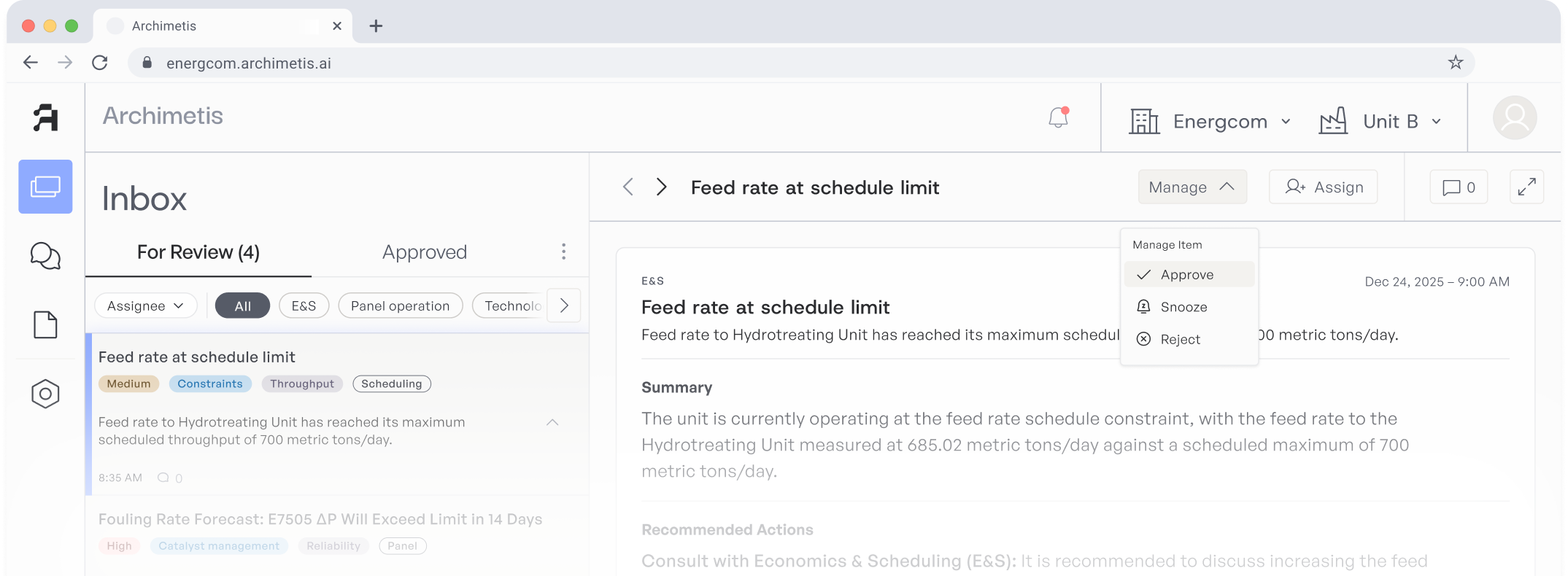
Instead of scanning dozens of trends, Archimetis flags the few things that matter, explains why they’re abnormal, and suggests what to check first.

Unusual reactor conditions are detected over nightshift. Archimetis identifies possible causes and begins to triage and prioritize the actions required for operations. Engineers are in control—even before their morning meeting.


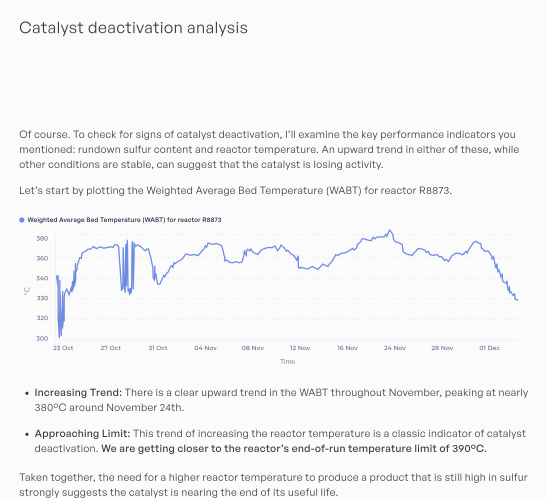
Archimetis walks through catalyst behavior, feed quality, and spec performance, then forecasts remaining life and what’s driving degradation.






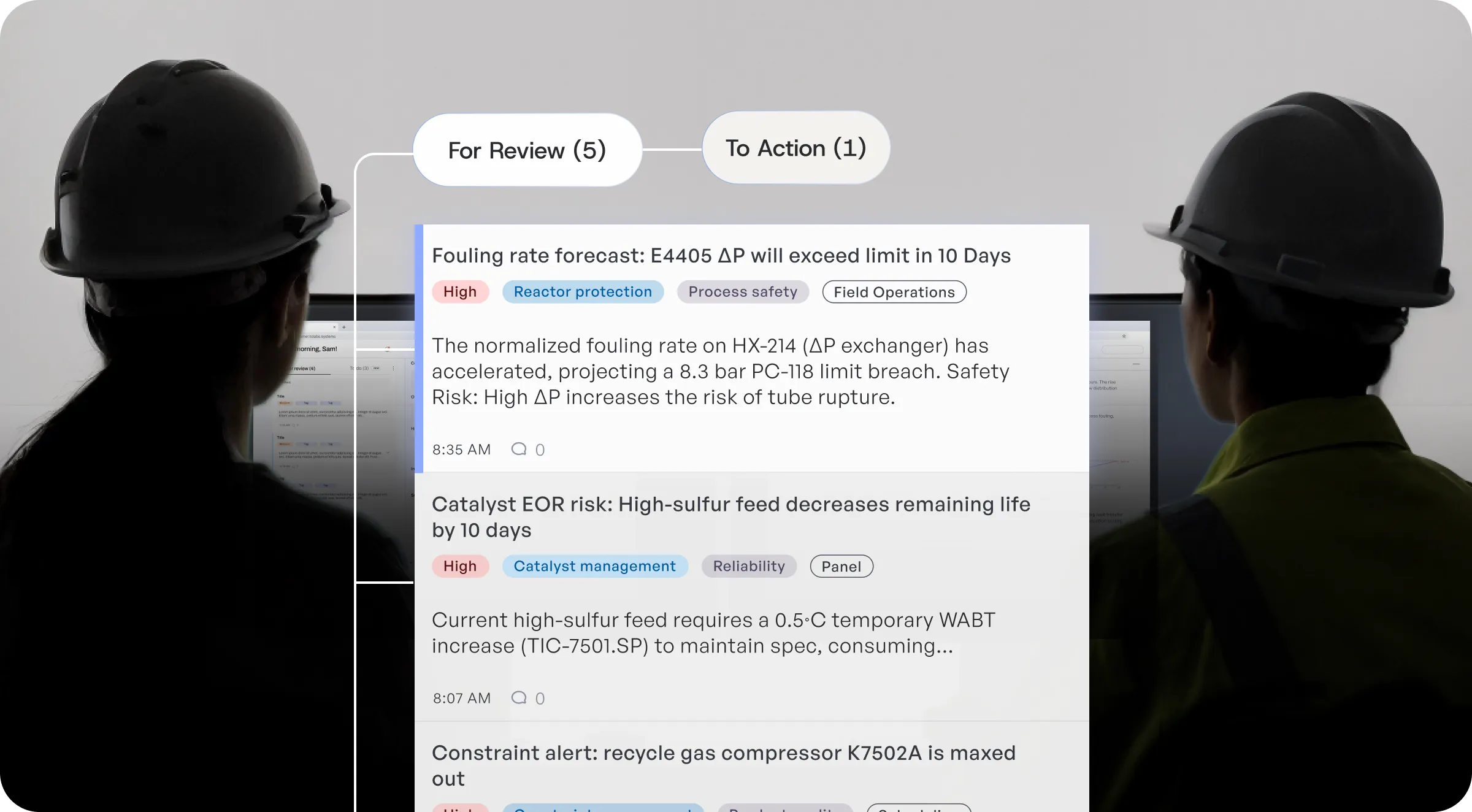
Instead of scanning dozens of trends, Archimetis flags the few things that matter, explains why they’re abnormal, and suggests what to check first.
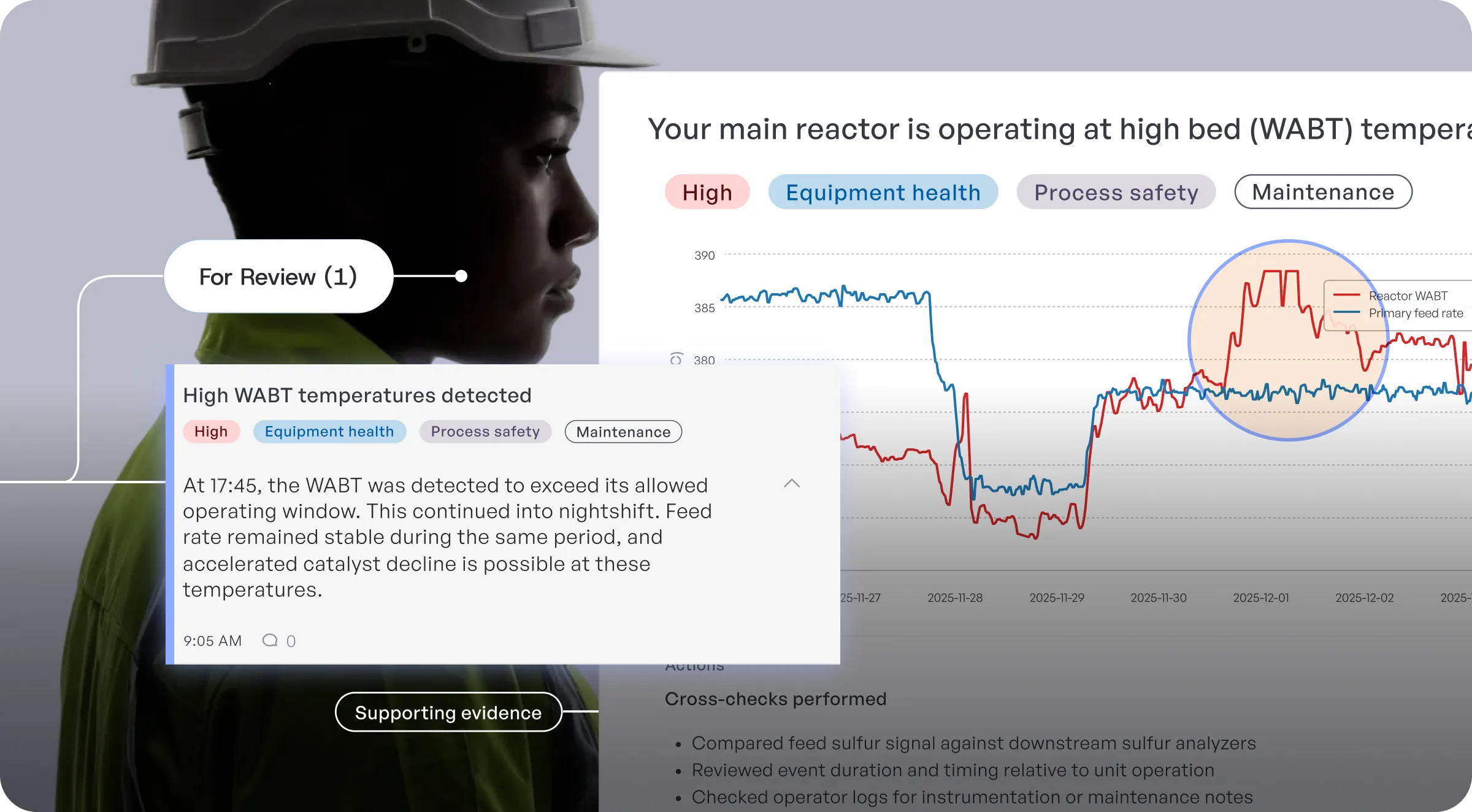
Unusual reactor conditions are detected over nightshift. Archimetis identifies possible causes and begins to triage and prioritize the actions required for operations. Engineers are in control—even before their morning meeting.
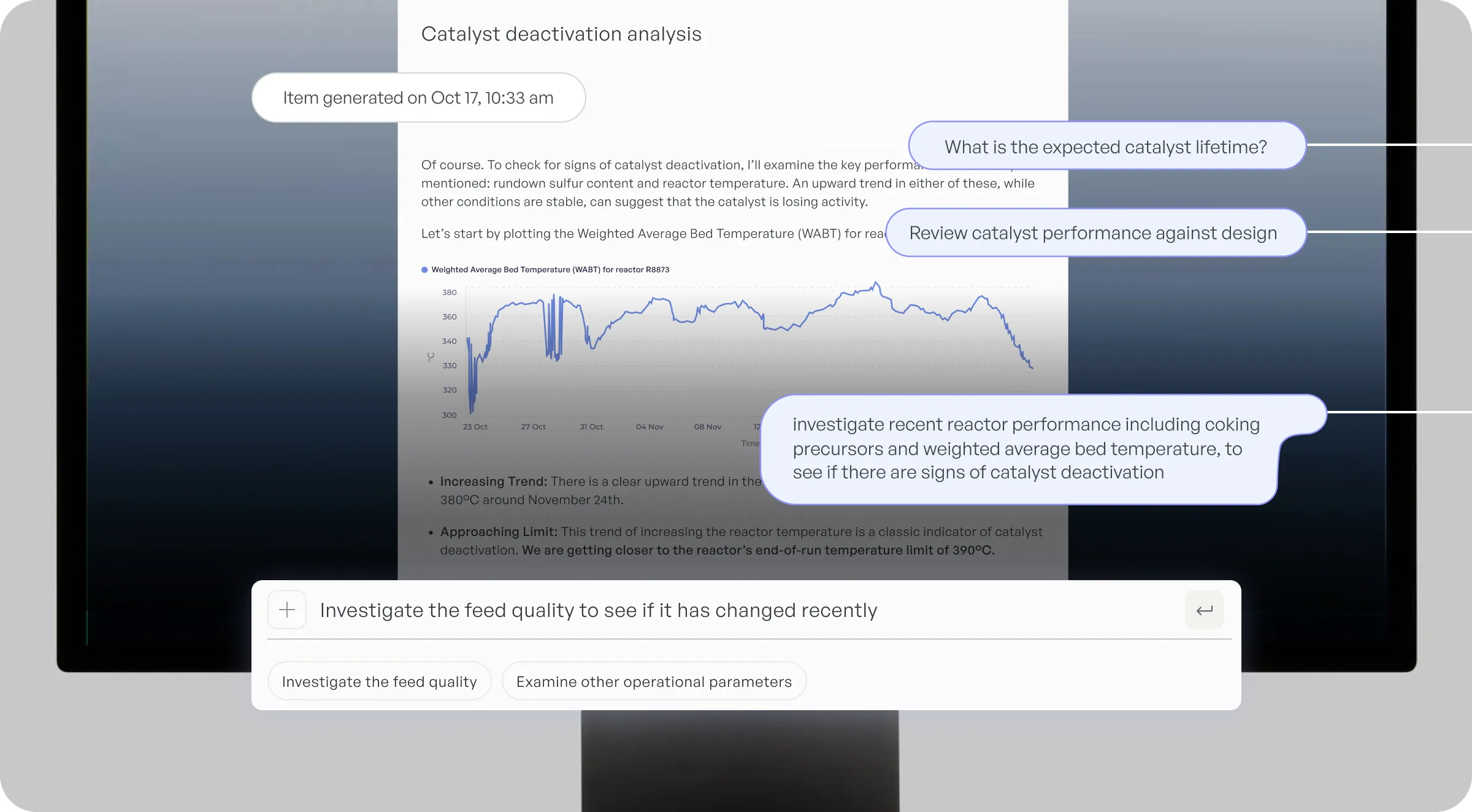
Archimetis walks through catalyst behavior, feed quality, and spec performance, then forecasts remaining life and what’s driving degradation.
Why this matters
More data
than ever.
Same number
of brains.
A massive increase in digitization has given teams more sensors, reports, and dashboards than they could ever process.
But it didn't multiply judgement.
Archimetis turns data into action, showing the reasoning behind every recommendation so engineers stay in control.

AI + Human Expertise (not AI Instead of Humans)
Instead of asking humans to stare at more dashboards, we give them an AI partner.
See more and act faster
Archimetis reads live process data alongside history, incident notes, constraints, and documentation to understand what’s happening across the plant.
It spots weak signals, emerging risks, and improvement opportunities before they escalate, and converts them into clear, ready-to-act recommendations.
Steer decisions
with human judgment
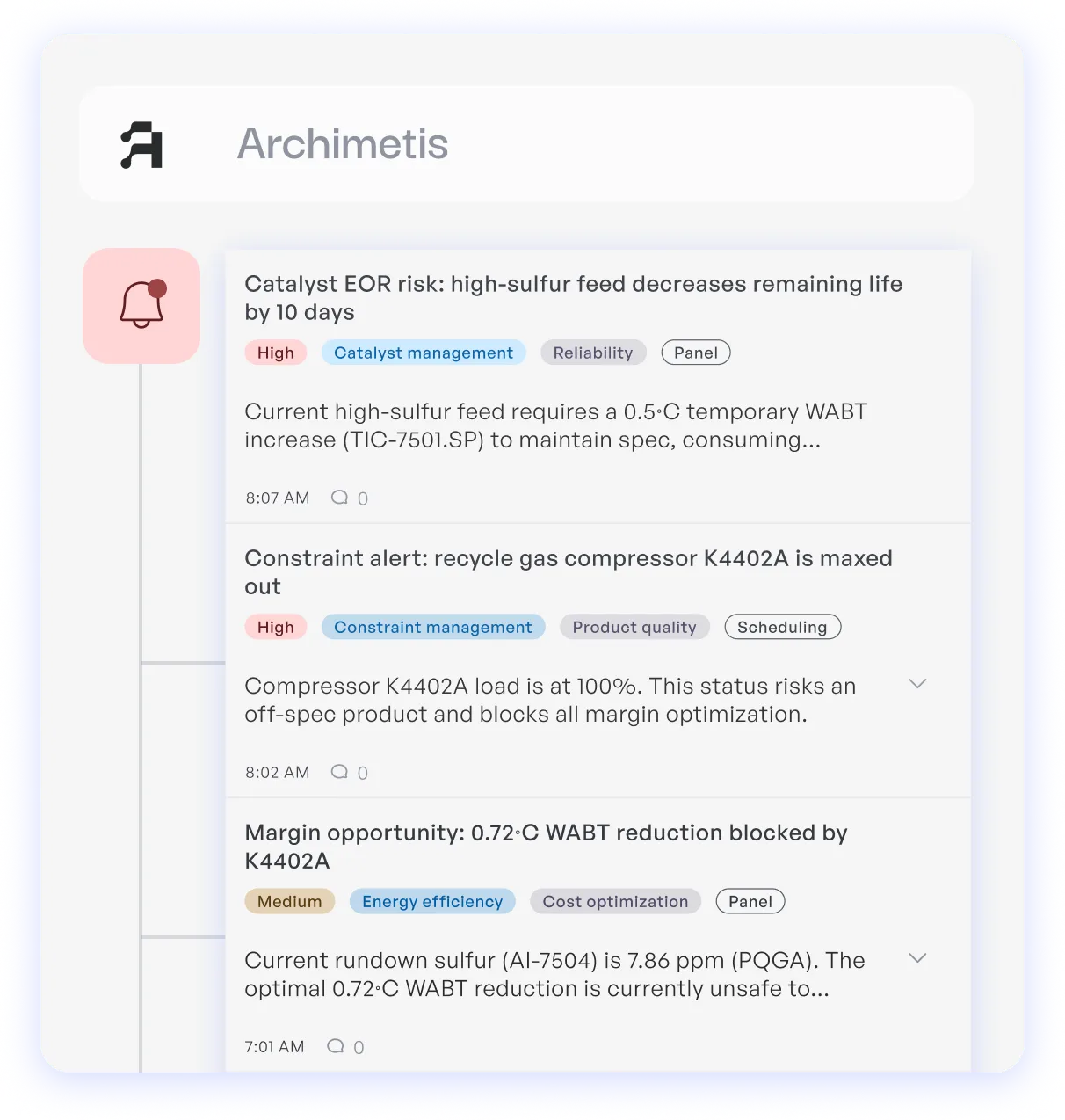
Engineers define the decision space. They set constraints, validate assumptions, and inject real operating context into the analysis.
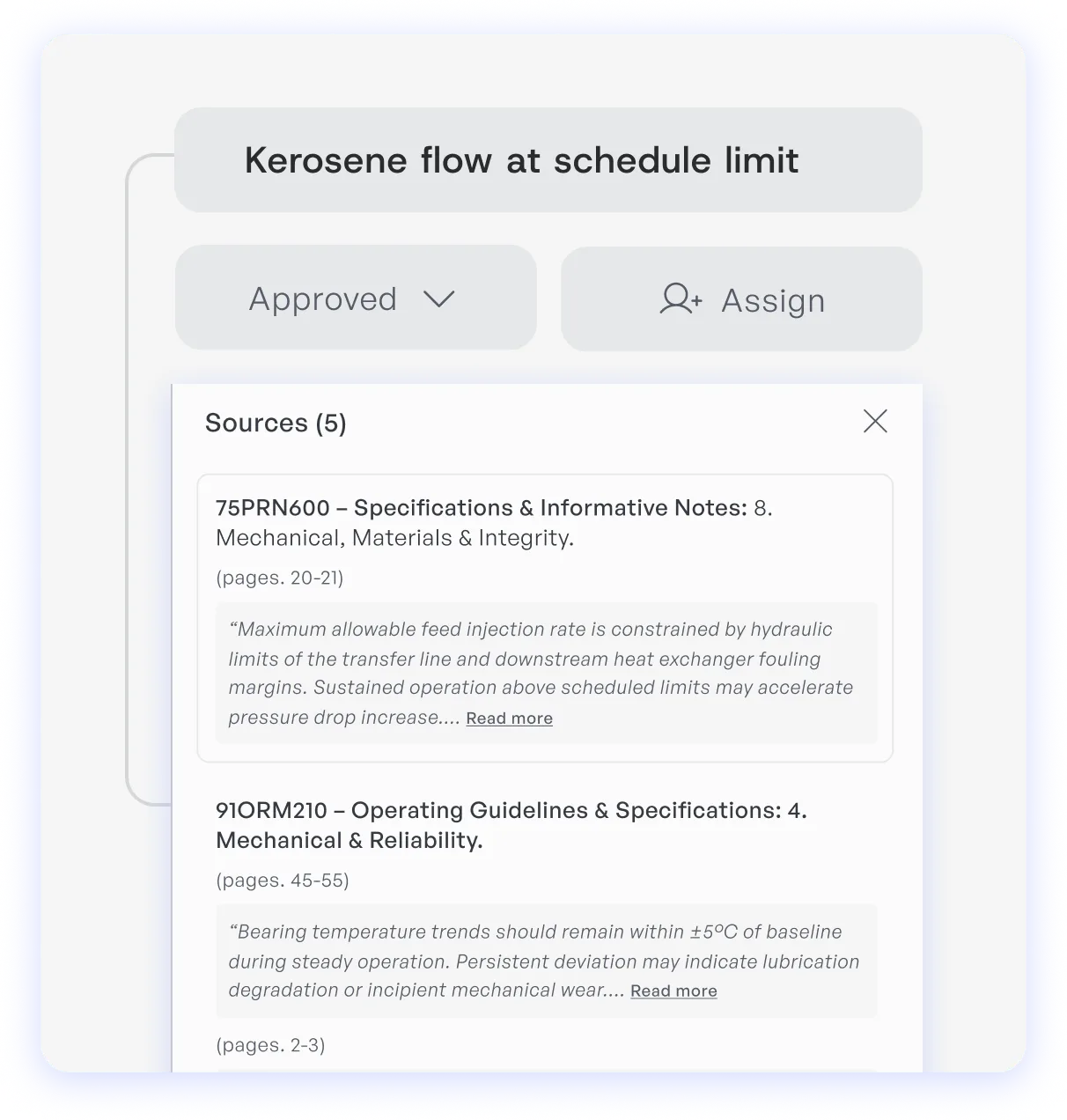
Reasoning is fully traceable. Every conclusion can be traced back to live data and plant documentation, making recommendations easy to inspect, challenge, and refine.
Four ways we improve how your plant runs




What this looks like in real refineries.


From safety studies to live risk prioritization
Archimetis starts from your existing safety studies and risk analyses, then checks each high-consequence scenario against live operating data.
It shows which risks are theoretical and which ones are actively being challenged, helping teams act before conditions deteriorate.
What are our top 5 process safety risks right now?
Based on the nature of our facility, the most significant risks are very concentrated in the HDS unit, due to the high pressures, high temperatures, flammable hydrogen, and toxic H₂S involved in the hydrotreating process.
To provide a data-driven answer rather than a general one, I suggest we consult the plant's formal risk assessment documentation. Which path seems best to you?
Which path seems best to you?
1. Broad, Plant-Wide Search: We can search through all available risk, assessments (like Bowtie and LOPA documents) to find the most significant documented hazards for the entire refinery.
2. Focused HDS Investigation: We could concentrate on the HDS unit as its a high-hazard area, and identify the primary risk scenarios specific to its operation.
3. Specific Hazard Analysis: We could start with a known type of hazard, for example: Loss of Containment” and use the bowtie analysis tool to explore its causes and consequences within our plant.
Let’s focus on the HDS unit
To identify the top risks for this unit, I’ll search our documentation for formal risk assessments, such as Bowtie or LOPA studies, that specifically cover the HDS unit. These documents are designed to outline the highest-consequence scenarios.
✓ Searching for HDS risk assessment documents...
1. Reactor Temperature Runaway
Hazard: A failure in the reactor charge heater (F4405) temperature controller could lead to a runaway reaction and coking inside the reactor:
Consequence: This is the most severe scenario, potentially causing the reactor to exceed its design temperature, leading to a catastrophic loss of containment, fire, and/or explosion. The documentation indicates a potential for more than 3 fatalities and major asset damage.
2. High-Pressure Flammable Release
Hazard: A release of liquid feed, product, or hydrogen from high-pressure equipment like the feed pumps (F4455A/B), product pumps (P4455A/B), or associated heat exchangers.
Consequence: A pool fire, jet fire, or flash fire, with a potential for up to 3 fatalities and significant asset damage. The primary cause cited is internal corrosion or pump seal failure.
3. Hydrogen-Rich Vapor Cloud Explosion (VCE)
Hazard: A release of hydrogen-rich vapor from either the H₂ compressors (C7505/C4406) or the low-pressure separation section (P4405, P4405).
Consequence: The formation of a vapor cloud that, upon ignition, could lead to a VCE or fire, resulting in up to 3 fatalities. A key threat is liquid carryover into the compressors.
4. Toxic Gas Release (H₂S)
Hazard: A loss of containment from equipment handling sour water, such as the sour water pumps (P4405A/B) or the cold low-pressure separator (P4406).
Consequence: The formation of a toxic H₂S gas cloud, posing a significant risk to personnel health and safety from exposure.
5. Corrosion-Driven Failures in Auxiliary Systems
Hazard: Releases from the light hydrocarbon slops system or the amine (DIPA) system.
Consequence: Fire, explosion, or a toxic release. These scenarios are often driven by specific corrosion mechanisms like Corrosion Under Insulation (CUI), pitting in low-flow areas, or corrosion in turbulent, high-velocity zone.
The next logical step would be to assess the health of the safety barriers designed to prevent these events. Which of these risks would you like to investigate further?
Assess risk number 1 with the actual plant data / performance
Let’s assess the risk of a reactor temperature runaway by examining the performance of the actual safety barriers in place.
The primary safeguard against this scenario is the temperature controller for the reactor charge heater, C4401, which manages the temperature of the feed going into the reactor (R4402). A failure here could lead to overheating. We also have critical alarms and operator intervention as further layers of protection.
To evaluate the performance, I will plot the following key parameters for the reactor over the past month:
Reactor Inlet Temperature: The temperature of the feed leaving the furnace and entering the reactor.
Reactor Inlet Temperature Setpoint: The target value for the inlet temperature.
Reactor Outlet Temperature: The temperature of the product leaving the reactor.
Weighted Average Bed Temperature (WABT): A key indicator of the overall temperature and reaction rate inside the catalyst beds.
Reactor Outlet Temperature Limit: The maximum safe operating temperature, which is 390 °C.
This will show us how well the temperature is being controlled and how close we have been to the operational safety limit.
The analysis is complete. Here is the performance data for the reactor’s key temperatures over the last month.
Reactor Temperatures & Setpoints
✓ Assessing reactor temperature performance against safety limits...
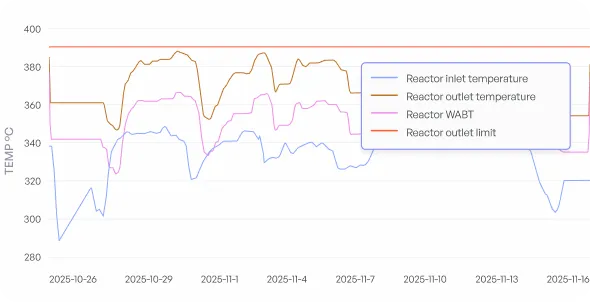
Here’s what the data shows:
Stable Control:
For the most part, the reactor temperatures (inlet, outlet, and WABT) are stable and move together, indicating the control system is functioning. The actual inlet temperature follows the setpoint reasonably well.
Safety Margin is Narrowing:
The most important observation is the gap between the actual Reactor Outlet Temperature and the 390 °C safety limit. On two occasions, around October 28th and November 17th, the outlet temperature climbed to over 385 °C. This leaves less than a 5 °C margin before hitting the maximum design temperature, which is a significant concern.
While we haven’t had an actual runaway event, operating this close to the safety limit reduces our ability to respond to any further process upset. It suggests that the safety barrier, while not having failed, is being severely challenged.
This leads to the question: Why are the reactor temperatures running so high?
I have a few hypotheses we can investigate:
- Feed Composition Change
- Controller Performance
- Catalyst Deactivation
Which of these paths would you like to explore first?

Start from the
plant’s own safety logic.
Archimetis begins by reading existing Bowtie and LOPA documentation to identify the highest-consequence scenarios, using the plant’s approved risk framework, not a generic AI model.
Are these risks being challenged right now?
Each top risk is immediately checked against live and historical operating data to see whether safety margins are being eroded today, not just on paper.
Are our protections still doing their job?
Archimetis evaluates whether operational safety barriers (like temperature control) are being stressed during upsets—using control performance, not alarms or trips.
What could we focus on?
Archimetis turns complex temperature data into instant visual clarity, allowing engineers to spot trends, anomalies, and safety margins at a glance.
Where should we look next?
Rather than issuing alerts, Archimetis frames the next best investigation, like controller tuning, feed variability, or upstream causes, so engineers stay in control.

How we turn your data and expertise into decisions.
01
Integrate your plant
Connect DCS/historian data, integrity systems, incident logs, and process safety studies into a single model of your plant.
02
Learn from experience
Archimetis ingests plant documentation, manuals, historical reports, and incident notes. This knowledge becomes a living system that learns from every shift, decision, and outcome to preserve and scale institutional expertise.
03
Optimize Continuously
Archimetis monitors, diagnoses, and recommends actions with full reasoning and references - so every suggestion can be trusted, challenged, and improved.
How we turn your data and expertise into decisions.
01
Integrate your plant
Connect DCS/historian data, integrity systems, incident logs, and process safety studies into a single model of your plant.
02
Learn from experience
Archimetis ingests plant documentation, manuals, historical reports, and incident notes. This knowledge becomes a living system that learns from every shift, decision, and outcome to preserve and scale institutional expertise.
03
Optimize Continuously
Archimetis monitors, diagnoses, and recommends actions with full reasoning and references - so every suggestion can be trusted, challenged, and improved.
Built by experts. Backed by experience.
Archimetis is built by industry leaders who have spent decades working on the hardest AI and refining problems.
Refining experts who understand their customers

Hemme Battjes
Former Shell

Phil Higgins
Former VIVA & Shell

Tom Richardson
Former DOW & BASF
Refining experts who understand their customers

Charles Crowell
Former Eastman & Milliken
Hemme Battjes
Former Shell
Tom Richardson
Former DOW & BASF

Paul Manwell
CEO
Former Chief of Staff, Google

Aaron Brown
CTO
Former Senior Director of Products, Google

Gary Boyer
Former Senior Staff Software Engineer, Google

David Tattersal
Former Lead PM, Code@Google

Stephen Ellner
Former Google Distinguished Engineer, Adwords
Technology leaders, product managers and engineers who build with deep data and AI expertise
Technology leaders, product managers and engineers who build with deep data and AI expertise
Paul Manwell
CEO
Former Chief of Staff, Google
Aaron Brown
CTO
Former Senior Director of Products, Google
Gary Boyer
Former Senior Staff Software Engineer, Google
David Tattersal
Former Lead PM, Code@Google
Stephen Ellner
Former Google Distinguished Engineer, Adwords
Enterprise-Grade Security Built In
Each customer runs in a fully isolated GCP environment with TLS 1.3 in transit, KMS-managed encryption at rest, and VPC-peered transfers—ensuring your operational data is never shared, mixed, or exposed.
We use least-privilege service accounts, no standing credentials, SSO/OIDC identity integration, and complete audit logs for every action—making internal security reviews smoother and meeting strict enterprise compliance expectations.
Archimetis does not require software agents, inbound firewall rules, VPN tunnels, or changes to your OT network. Data is shared through customer-approved, outbound-only, cloud-native mechanisms that keep your control systems isolated—and your IT team comfortable.
WHAT TO EXPECT
See how your best engineers work with AI that thinks like they do.
Get a personalized demo showing how our platform handles your specific operational challenges.
Live walkthrough with your data scenarios
Custom ROI analysis for your operations
Deployment roadmap tailored to your infrastructure